
Why Choosing the Right Vehicle Matters for Comfort Safety and Logistics
The wrong vehicle can turn a simple trip into a cramped, late, stressful ride before the engine even starts. A car can have enough seats and still be the wrong choice if the bags do not fit, the steps are hard to climb, the route includes rough weather, or the pickup area cannot handle the vehicle.
Vehicle assignment sounds simple from the outside. Count the passengers, pick a vehicle, send it out. In practice, good assignment takes a fuller view of the trip. It looks at people, luggage, timing, road conditions, comfort, safety needs, and the details of pickup and drop-off.
That matters for airport runs, weddings, medical appointments, and long-distance transfers. The best vehicle is the one that fits the whole journey, not just the headcount.

Passenger count is only the starting point
Seats matter, but they do not tell the whole story. A vehicle listed for six passengers may not feel comfortable for six adults on a long ride, especially with coats, backpacks, child seats, or carry-on bags. A packed row that is fine for a 10-minute local trip can feel tight after an hour.
Passenger count also ignores how people actually move.
A family with two children may need room for car seats, a stroller, and snacks within reach. A group heading to a formal event may need more shoulder room so clothing does not wrinkle. Older riders may prefer easier entry and lower steps. A sports team may have equipment bags that take as much space as extra passengers.
Here is a simple way to think about it:
Trip factor | Why it changes the vehicle choice |
Number of passengers | Sets the minimum seating need |
Luggage and gear | Can quickly use up rear storage space |
Trip length | Longer trips need more personal room |
Rider mobility | Entry height and door size matter |
Event type | Clothing, timing, and arrival style can affect comfort |
Route and weather | Road conditions may call for a more stable vehicle |
One common mistake is treating the listed seat count as the real capacity. A better rule is to ask whether every passenger can sit with a seat belt, keep personal items secure, and ride without being pressed against bags or other riders.
That is the practical meaning of choosing the right vehicle. It is not a luxury concern. It is a planning decision.
Luggage can be the deciding factor
Luggage is often the part people underestimate. A group of four may fit easily in a sedan, but four large suitcases may not. Add golf clubs, a folded wheelchair, trade show materials, skis, or baby gear, and the plan changes fast.
Airline travel makes this more common. Many travelers bring a carry-on bag, a personal item, and sometimes a checked bag. Even if every person has only two pieces, a group of five may bring ten bags. Those bags need a secure place to ride.
Loose luggage in the seating area creates several problems:
It reduces legroom and comfort.
It can block doors or aisles.
It can slide during sudden stops.
It may slow down loading and unloading.
The National Highway Traffic Safety Administration advises that passengers should use seat belts properly and that loose items can become hazards during a crash or sudden stop. That is a clear reason to keep bags secured in the proper storage area whenever possible.

A smart assignment asks luggage questions early:
How many large suitcases are coming?
Are there strollers, walkers, wheelchairs, musical instruments, or sports bags?
Will passengers need access to any items during the ride?
Is the group returning with more items than they started with?
That last question matters for shopping trips, conferences, and vacations. A vehicle that works on the outbound trip may feel too small on the return.
Comfort affects more than mood
Comfort has a direct effect on how people feel, move, and arrive. A rider who spends an hour with knees pressed into a seat or bags underfoot may arrive tired or irritable. For business travel, special events, and medical trips, that matters.
Comfort depends on more than soft seats. It includes:
Space to sit naturally
Good airflow and temperature control
Smooth entry and exit
Enough room for personal items
A quiet enough cabin for conversation
A ride height that suits the road and passengers
Trip length changes the standard. For short city rides, a smaller vehicle may work well. For longer highway travel, extra space becomes more important. The Federal Highway Administration has long reported that Americans take many trips by car each day, but trip purposes vary widely. A quick commute, a family airport transfer, and a four-hour group ride place very different demands on the vehicle.
Comfort also affects timing. If the vehicle is too tight, loading takes longer. People need to rearrange bags, shift seats, fold and unfold items, or make several attempts to close the rear door. Those minutes add up at hotels, airports, stadiums, and event venues where curb time is limited.
Comfort also helps people cooperate. Passengers can enter faster, settle faster, and exit without a pileup at the door. A few inches of space can make the difference between an efficient pickup and a delay.
Safety begins with the match between vehicle and trip
Safety is not only about the driver. It also depends on whether the vehicle suits the load, the passengers, and the road.
Every passenger needs a proper seat and seat belt. Children need the correct child seat for their age, size, and local law. The Centers for Disease Control and Prevention states that seat belts reduce serious crash-related injuries and deaths. That fact alone makes overcrowding unacceptable, even for a short ride.
Vehicle weight also matters. Manufacturers set limits for passengers and cargo. These limits appear in the owner’s manual and often on a label inside the driver’s door area. Loading above that safe limit can affect braking, handling, and tire wear. A new reader does not need to know the mechanical details to understand the risk. A vehicle carrying too much weight may not respond as designed.
Weather is another factor. Heavy rain, snow, high winds, steep roads, and unpaved areas can all change the best choice. A vehicle with more ground clearance may work better for uneven rural roads. A smaller car can be easier to place in tight city streets. A larger vehicle may give a group more room, but it may also need more space to turn and park.
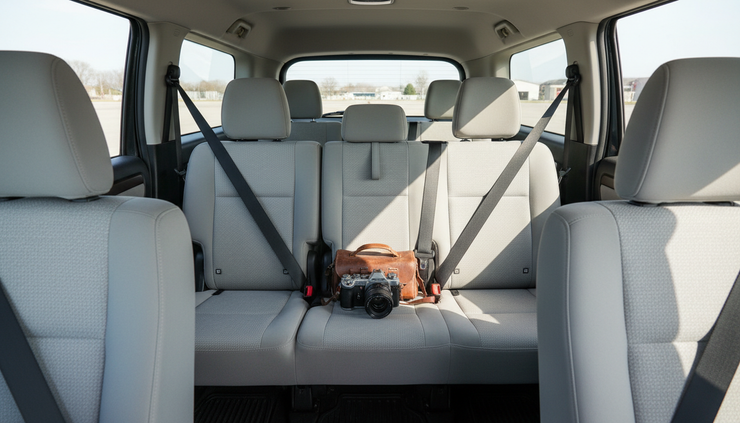
Safety planning should include practical questions:
Can each person sit in a real seat with a working belt?
Can child seats be installed correctly?
Can passengers enter and exit safely?
Can luggage be secured away from feet and doors?
Is the vehicle suited to the road and weather?
The safest answer is usually the least dramatic one: choose enough vehicle before the trip starts, rather than trying to make a poor fit work at the curb.
Logistics can make or break the ride
A good vehicle choice must fit the travel plan itself. The pickup location, traffic pattern, parking access, loading time, and drop-off rules all matter.
An airport pickup is a good example. A large group may need a van, but the airport’s pickup zone may limit where that van can stop. A downtown hotel may have a low entrance or a narrow curb. A wedding venue may have gravel paths, soft lawns, or limited turning space. A school or medical facility may require faster loading and clear door access.
Nationwide travel adds more variation. A trip in a dense city may favor a smaller vehicle that can handle tight curbs. A rural transfer may favor a vehicle with more storage and a more comfortable ride over longer distances. A mountain route in winter may require different planning than a flat coastal route in summer.
Timing is part of logistics too. If a group has a hard arrival time, a larger vehicle may reduce risk by allowing everyone and everything to load at once. By contrast, splitting a group into two smaller vehicles can help when pickups happen at different addresses or when parking is limited.
Neither choice is always better. The better choice depends on the route.
The vehicle should match the purpose of the trip
The same group may need different vehicles on different days. Five people going to dinner downtown have one set of needs. The same five people going to the airport with luggage have another. The same five people traveling two hours to a conference may need more room still.
Here are common trip types and what usually matters most.
Airport transfers need space and time control
Airport rides involve luggage, flight times, and crowded pickup zones. The vehicle must have enough storage so bags do not slow the group down. It also helps when doors open wide and passengers can load quickly.
For early morning or late-night flights, comfort matters too. Riders may be tired, traveling with children, or handling multiple bags. A slightly larger vehicle can reduce stress.
Event transportation needs smooth arrivals
Weddings, concerts, sports events, and formal dinners all put pressure on timing. People often travel in dress clothes, carry small bags, and arrive at crowded entrances. The right vehicle allows riders to exit cleanly and stay together.
For formal events, tight seating can be more than uncomfortable. It can make clothing wrinkle, increase loading time, and create a poor arrival experience.
Medical and care-related trips need easy access
Some riders need extra time, low steps, or room for mobility aids. A vehicle may have enough seats but still be hard to use if the entry is too high or the door opening is narrow.
For these trips, comfort and safety overlap. Easy entry reduces strain, and clear floor space reduces tripping risk.
Group travel needs room for people to be people
Groups bring variation. One person may have a large backpack. Another may need space for a musical instrument. Someone else may get motion discomfort and prefer a certain seat. A good assignment leaves enough room for real human needs, not just a perfect seating chart.
A simple framework for better vehicle assignment
Good vehicle assignment follows a basic order. It does not require special knowledge, only careful questions.
Start with the true passenger count
Count adults, children, and anyone who needs extra support. Include child seats if needed.
List every bag and large item
Ask about checked bags, carry-ons, strollers, walkers, sports gear, instruments, and packages.
Match the vehicle to the longest part of the trip
A vehicle that feels acceptable for five minutes may not work for 90 minutes. Plan around the hardest section, not the easiest.
Check entry and exit needs
Think about step height, door width, and whether anyone needs help getting in or out.
Review the pickup and drop-off locations
Consider curbs, parking rules, tight streets, slopes, and loading areas.
Leave room for the unexpected
Extra bags, bad weather, traffic, and delayed flights are common. A small buffer can prevent a small problem from becoming a major delay.
This approach works because it treats the vehicle as part of the service, not just the container for the trip.

Common signs the vehicle is too small
A vehicle is probably too small if any of these things happen before departure:
Bags must sit on laps or block legroom.
Passengers cannot buckle seat belts comfortably.
The rear storage area will not close safely.
People need to climb over luggage to enter or exit.
Loading takes far longer than expected.
The group starts debating who should sit where because no seat feels workable.
These signs are not minor annoyances. They predict the rest of the ride. If the trip starts with crowding, the ride will likely feel worse as time passes.
The fix is not always the largest vehicle available. The fix is the best match. Sometimes that means a roomier van. Sometimes it means two vehicles. Sometimes it means a smaller vehicle with better access at the destination.
Bigger is not always better
A larger vehicle can solve space problems, but it can create other ones. It may need more room to turn, more time to load, and a larger legal stopping area. It may not fit under some covered entrances. It can be harder to place near tight curbs.
That is why good assignment balances three things:
Capacity
Enough seats and storage for the people and items.
Access
A vehicle that can reach the pickup and drop-off points safely.
Experience
A ride that feels comfortable for the full route.
The right answer sits where those three overlap. A vehicle that has space but cannot stop near the entrance may not serve the trip well. A vehicle that can stop anywhere but cannot hold the luggage is not enough either.
No vehicle choice should be based on a single number. The better question is simple: will this vehicle handle the real trip from door to door?
A well-assigned vehicle makes the journey feel easier before anyone notices why. Bags fit. People buckle up. Loading is calm. The driver has a vehicle suited to the route. Passengers arrive without feeling packed, rushed, or worn out.
That is the real value of thoughtful vehicle assignment. It turns transportation from a guess into a plan, and a better plan usually leads to a safer, calmer, more comfortable ride.
At Divine Transportation Services, we take the time to understand your transportation needs before assigning a vehicle. Whether you need an airport transfer, city-to-city transportation, group travel, corporate transportation, or cross-border service, we consider the details that matter.
Our goal is simple: the right vehicle, the right planning, and the right service for your journey.
Don't leave your transportation to chance. Choose Divine Transportation Services and experience professional planning, reliable service, comfortable travel, and peace of mind from pickup to destination.


Comments